The trade show calendar has been the default sourcing path for independent boutiques for decades. Twice a year, a buyer flies to a convention center, walks 100 booths in three days, places orders with a six-month lead time, and goes home to wait for inventory she committed to before she had any data on whether her customers wanted it.
That model is showing its age. Booth costs keep rising while wholesale minimums have not moved in any meaningful way, and the customer who walks into a boutique in 2026 wants something that twice-a-year ordering cycles cannot deliver: a curated selection that responds to what is happening on her phone this month, not what a buyer guessed about her tastes last October.
Most indie boutique owners already know this. They have been quietly building a different sourcing approach, piece by piece, without a name or playbook. This article is that playbook.

Why the Wholesale Model Worked (and Why It Doesn't Anymore)
Wholesale was not designed for boutiques. It was designed for department stores, and the difference matters.
A department store buyer's job is to place predictable, large orders that fill a chain of stores with consistent inventory across geographies. Six-month lead times work for her because her buying cycle is structured around seasonal floor sets coordinated across all locations in the chain. Minimums of 500 to 5,000 units across a wholesale catalog are baked into her business model: she needs that volume to keep the racks stocked across her chain.
For an independent boutique, almost none of this logic applies. One store, sometimes two. A floor that turns every four to six weeks because regulars come back to see what is new. A customer base small enough that the buyer can name her customers by silhouette preference and credit card last four digits. Buying calibrated to volumes designed for a department store creates exactly the wrong inventory shape: too much of any one bag, too little variety across a season.
The wholesale system tolerated this misalignment for a long time because there was no alternative. Boutiques absorbed dead inventory, marked down what did not move, and called it the cost of doing business. The catalog you ordered in March was the same one every other boutique in your category ordered. Differentiation was the curation within a fixed pool, not the pool itself.
What changed is the supply chain. Faster sample-to-quote turnarounds, smaller production runs, and the disappearance of the assumption that a buyer needs to see a physical sample before she places an order — these have all made it possible to source outside the wholesale calendar entirely. The economic rationale for large minimums on the supplier side has softened, even if most wholesale catalogs have not yet repriced to reflect that.
The Hidden Cost of Trade Show Sourcing
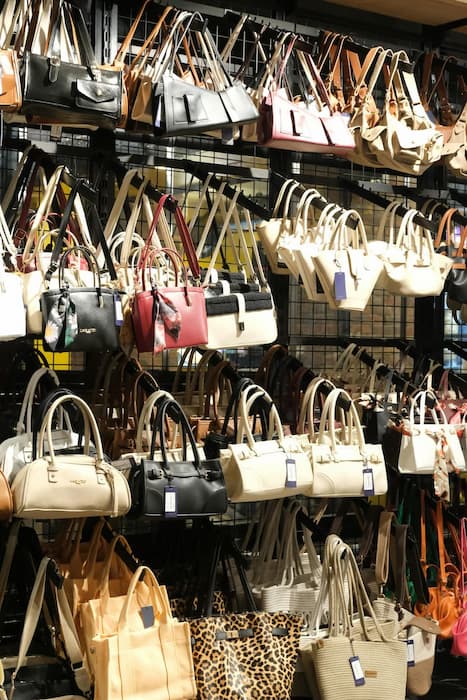
A trade show appears to be a sourcing event from the outside. The optics of walking the floor, seeing the lines, and placing orders suggest an active buying environment. In practice, most of what happens at a major trade show in 2026 is closer to industry theater than to sourcing. The buyers in attendance are largely there to confirm orders their parent organization or buying group has already pre-decided.
The economics for an independent boutique are punishing once you account for the full cost. A buying trip to a major US trade show (Coterie, MAGIC, or a regional equivalent) typically requires plane tickets, two to four nights in a convention-rate hotel, food on the road, and three days off the floor of your own store. For a one-store boutique, that is real revenue forgone in addition to the cash spent. The trip has to produce orders that meaningfully outperform what could have been sourced from her phone, in her store, between customers.
For most independent buyers, that math has been quietly negative for several seasons. The orders placed at the trade show are with the same suppliers, offering the same wholesale terms, minimums, and 90 to 180-day delivery windows. The differentiation is marginal. The cost is fixed.
There is also a less measurable cost. A trade show gives you three days inside the wholesale calendar's logic, meaning three days when you are thinking about your assortment in the wholesale system's terms rather than in your customer's. It is hard to come back from Las Vegas with a sourcing strategy designed around what your specific Brooklyn, Bristol, or Brisbane regulars want next month. The trade show optimizes you to think like every other buyer in the room, because every other buyer in the room is being shown the same product.
What Boutique Customers Actually Want in 2026
The customer who walks into an independent boutique in 2026 has different reference points than the customer who walked in five years ago.
She has already seen the bag on TikTok and likely six other versions of it. She has saved one to her favorites, asked about it in a group chat, and arrived at your store either to find that exact bag or something better. The boutique is no longer her first exposure to the product. It is her validation point. By the time she walks in, she has already done research that a 2018 customer would have outsourced to the boutique buyer.
This shifts the meaning of curation in practice. The boutique that can show her something she hasn't already seen on her phone is the one that gets her credit card. The boutique that shows her the same wholesale-driven assortment she has seen at three other independent stores in her city has lost the differentiation that justified her trip.
The customer also expects faster turnover. She comes back in five weeks and notices if the floor looks the same as it did on her last visit. She does not articulate this as a complaint. She just stops coming back. Repeat-visit frequency typically softens when assortment freshness slips below a four-to-six-week refresh cadence. The customer cannot tell you why she lost interest. She can only tell you, with her behavior, that she did.
There is one more thing worth naming. The price point ceiling for an unknown brand has moved. Customers in 2026 will spend $90 to $180 on a bag from a boutique they trust without needing the bag to carry a recognizable label. The legibility comes from the boutique's curation, not from the brand on the bag. This is the leverage point that small batch sourcing unlocks: a boutique with sharp taste and fast turnover can sell a bag for $140 that her customer has never heard of, because the boutique itself has become the trust signal.
The New Sourcing Playbook
The boutique sourcing approach that works in 2026 has four steps. None of them is conceptually new. What is new is that they can now be assembled into a working sourcing process that does not require a wholesale account, a trade show booth, or a six-month commitment.
Step 1: Spot, do not subscribe. The bag your customer wants is already somewhere on the internet. You see it in your TikTok feed. You see it tagged in a customer's Instagram story. You see it on a competitor's website at a price you know you can beat with the right sourcing. The first step is to make spotting deliberate. Running this approach successfully takes 15 to 20 minutes a day inside your own customer's content stream. Not as a marketing exercise. As inventory research.
Step 2: Source on demand. Once you have spotted a candidate bag, the question is how to source it without committing to wholesale quantities. Submit a photo or a link on Find My Bag, and we'll quote within 24 hours: sourcing cost, quality notes, and shipping timeline. Order any quantity. One unit to test. Twenty to fill a window. A hundred, once your customer data justifies it. The model removes the main reason most boutiques pass on trending bags they actually believe in.
Submit a photo or link. Quote in 24 hours. Any quantity.
No wholesale account. No trade show. No six-month commitment. You source what your customers actually want, when they want it.
Find My Bag → Free to submit · Quote in 24h · Zero commitmentStep 3: Test before committing. A trending bag you believe in is still not the same as one your specific customer base will buy. The third step is to test the bag in a small batch (8 to 20 units is typical for a first test) placed in your most visible channel. A window display. A featured Shopify position. An Instagram post tagged to your store. The test is not the sale. The test is the data: at what price point does it convert, what customer segment buys, and how fast does inventory move?
Step 4: Scale only what works. The boutiques that get the most leverage from this approach are those that reorder quickly on what worked and exit quickly on what did not. A bag that sells eight out of ten units in two weeks is a candidate for a 30-unit reorder. A bag that sells 2 of 10 in 4 weeks is a signal to mark down and rotate. The discipline is not the sourcing. It is the willingness to call it on a product that did not perform and move on.
The pattern that emerges from running this approach for one full retail season is that a boutique stops carrying any single product for longer than the customer demand actually justifies. Inventory is always either in active rotation or already cleared. Markdown becomes a strategic exit, not a margin emergency.
How to Test a Style Before Committing 50 Units
The fastest way to lose money in independent retail is to skip the testing step and order at scale on a hunch. The fastest way to lose customers is to test so cautiously that the floor never refreshes. Testing has to be cheap enough to do often and serious enough to produce real data.
A working test for a new style runs on three signals.
The save signal. A pre-launch Instagram post or Story showing the bag (no price, no link, just the product) generates saves and shares from your existing audience. This is the cheapest data you can collect. If the post performs noticeably better than your average, the bag has pull within your audience. If it performs in line with your average, the bag is not the wrong product, but it is not yet a candidate for a feature placement. If it underperforms, the bag is not for your customer base.
The DM signal. Customers who DM with questions (price, availability, sizing, when it lands) are converting two stages in a single message. They have moved past awareness into purchase intent. Three to five inbound DMs on a single post is a strong directional signal. DM volume on a teaser tends to predict pre-launch sell-through reasonably well.
The walk-in signal. For physical retail, the third signal is direct. A bag placed in a window or in a featured floor position generates conversation with walk-ins within the first three to five days. Customers ask about it. They pick it up. They photograph it. The behavior is observable in real time. A bag that sits untouched in your window for a week is telling you something useful, even if the answer is no.
The test order itself should be small. Eight to twelve units for a first test is a working number for most boutiques in the $90–$180 price band. The order is large enough to create the in-store presence the bag needs to perform, and small enough that a wrong call is recoverable on a single end-of-season markdown without damaging the season's overall margin.
What testing replaces is the wholesale model's implicit assumption that the buyer is correct. The buyer is not always right, and the boutiques that treat their own taste as data rather than as the answer are the ones that consistently outperform.
From Sourcing to Private Label
Sourcing is a complete business model in itself. A boutique that runs the playbook above for a full retail season can build margin, customer loyalty, and curation reputation without ever putting her own name on a bag. Some of the most respected independent retailers never make the move into private label, and that is a coherent strategic choice.
For others, there is a moment when the math shifts. After running 15 to 20 small-batch drops over a season or two, a boutique owner has data she could not have had any other way: which silhouette her customers consistently buy, which colorway converts, which price point holds margin, which customer segment responds to which aesthetic. That data is not theoretical. It is observed behavior, repeated across multiple drops, with real money behind every signal.
The case for moving into private label gets strong when three things are true: the data is consistent across at least three drops, the sourcing margin has plateaued (because the supplier markup is now the structural ceiling on your retail price), and the boutique owner has the cash flow to absorb a 60 to 90 day production cycle without disrupting her core operations.
Private label is not the same business as sourcing. The capital cycle is longer. Minimum production runs are higher (typically 100 to 300 units per style for handbags, depending on the supplier and the construction). The financial commitment is meaningful enough that it should not be undertaken on the strength of a single hot-selling drop. Start Your Bag Brand is the bridge for boutiques ready to make that transition. The same sourcing relationships that powered the test drops carry through into the private-label production. The boutique gets to put her name on a bag her customers have already validated, which is the cleanest possible launch for an own-label collection.
Most boutiques will not make this move in their first year. The ones who do typically have already proven the demand on three to five iterations of the same silhouette in different colorways or materials. Private label rewards confidence based on data. It punishes confidence based on enthusiasm.
Conclusion
The boutique sourcing model that worked for 30 years was a product of its supply chain. The new model is also a product of its supply chain — one that has finally caught up with what independent retailers actually need. The shift does not require a manifesto. It requires the willingness to source one bag, then another, then a third, and to trust the data more than the calendar.
If you want the operational details of how no-minimum sourcing works in practice (the quote process, quality control, sample timelines, shipping logistics), our existing playbook covers each step. For boutiques ready to source their first bag this way, Find My Bag is where the process begins. Submit a photo or a link, receive a quote in 24 hours, and order what fits your strategy.